
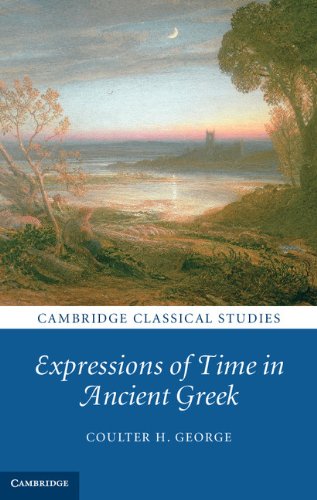
Expressions of Time in Ancient Greek (Cambridge Classical Studies)
Product details
| Management number | 232020505 | Release Date | 2026/06/18 | List Price | US$14.48 | Model Number | 232020505 | ||
|---|---|---|---|---|---|---|---|---|---|
| Category | |||||||||
How did Ancient Greek express that an event occurred at a particular time, for a certain duration, or within a given time frame? The answer to these questions depends on a variety of conditions - the nature of the time noun, the tense and aspect of the verb, the particular historical period of Greek during which the author lived - that existing studies of the language do not take sufficiently into account. This book accordingly examines the circumstances that govern the use of the genitive, dative, and accusative of time, as well as the relevant prepositional constructions, primarily in Greek prose of the fifth century BC through the second century AD, but also in Homer. While the focus is on developments in Greek, translations of the examples, as well as a fully glossed summary chapter, make it accessible to linguists interested in the expression of time generally. Read more
| ASIN | B00JXII8B8 |
|---|---|
| XRay | Not Enabled |
| ISBN13 | 978-1139982528 |
| Language | English |
| File size | 2.0 MB |
| Page Flip | Enabled |
| Publisher | Cambridge University Press |
| Word Wise | Not Enabled |
| Print length | 340 pages |
| Accessibility | Learn more |
| Screen Reader | Supported |
| Part of series | Cambridge Classical Studies |
| Publication date | June 26, 2014 |
| Enhanced typesetting | Enabled |
Bestseller ranking
Herbal Remedies


Customers who viewed this product also viewed
Miscellaneous




Correction of product information
If you notice any omissions or errors in the product information on this page, please use the correction request form below.
Correction Request Form